


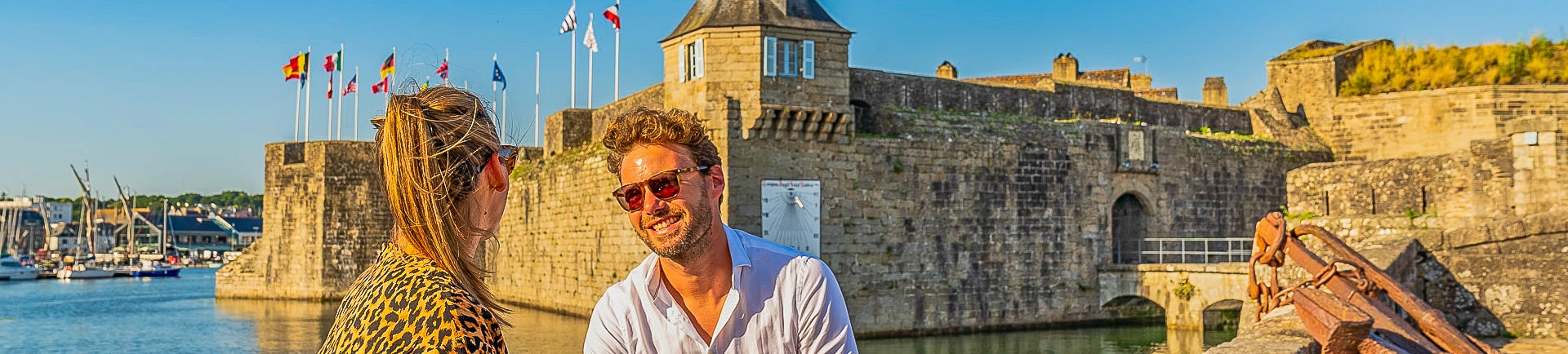
La Ville-Close is the historic center of Concarneau, Finistère’s 3rd-largest town and France’s 7th-largest fishing port. La Ville-Close is a must-see when visiting Concarneau. The blue city’s claim to fame is undoubtedly its fortified old town, whose fortifications are the result of warfare in the Middle Ages. Every year, the Ville-Close welcomes over 1.5 million holidaymakers and is one of France’s most visited historic monuments.
Find out everything you need to know about the walled town of Concarneau, before you visit, during your stay at our Concarneau Le Cabellou campsite.
The history of Ville-Close
The Ville-Close, the historic heart of Concarneau, was built on a rocky islet, the Conq, isolated by the water and mudflats of the Moros estuary. The walled town was originally a village with dwellings, a church, a hospital, a prison, a fountain, a well, etc., but it was quickly transformed into a stronghold at the request of the Dukes of Brittany. The island’s defenses were completed by a stone wall belt, and the town was enclosed by walls.
This was one of the first citadels in the region, and was occupied for 30 years by the English, before being liberated by Bertrand du Guesclin.
On the 350-meter-long, 100-meter-wide islet, the city is surrounded by granite ramparts 2.5 to 3 meters wide, with 9 towers and 3 gates: the Porte au Vin to the north, the Porte des Larrons and the Porte du Passage to the east.
In the 17th century, the walled town of Concarneau was redesigned and reinforced by Vauban.
Then, in the 19th century, it was once again modified by the army. The parapet was raised and a barracks and powder magazine were added. Then, in 1906, a belfry was built at the entrance over the former guardhouse, and became the emblem of Concarneau.
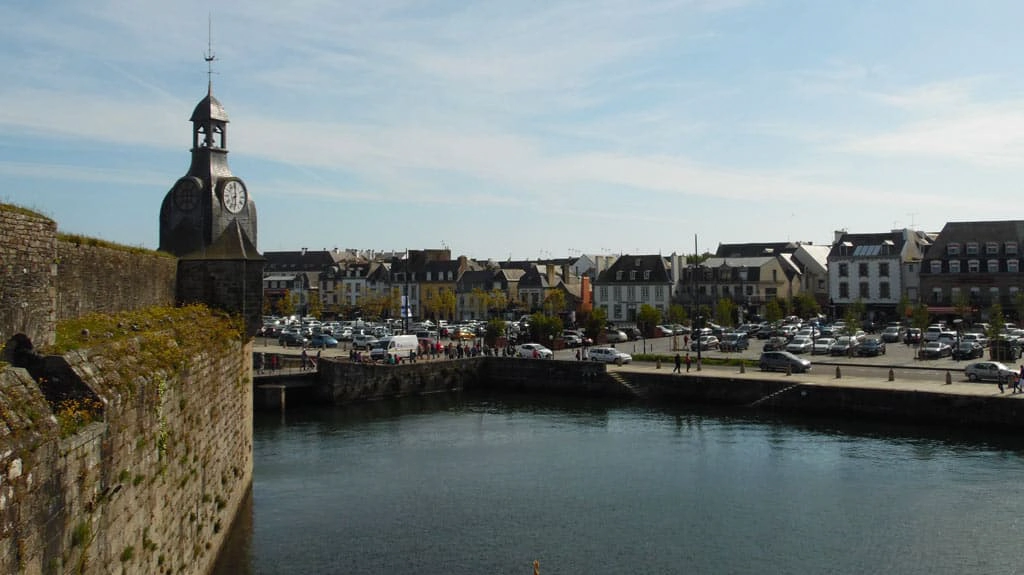
The ramparts of the Ville-Close classified as a Historic Monument
In 1898, the French Ministry of War took the decision to sell certain parts of the Ville Close de Concarneau following the decommissioning of the stronghold. This marked the start of a long series of negotiations between several parties with an interest in Concarneau’s fortifications: the Ministry of War and the Town of Concarneau, but also the Ministry of Fine Arts and Public Instruction, which became involved when the application was made to classify the ramparts of the Ville-Close as historic monuments.
And on February 27, 1899, Concarneau’s ramparts were listed as a Monument Historique. However, the final classification did not take place until 1913, and the town went from being a place of warfare to a place of art and history.
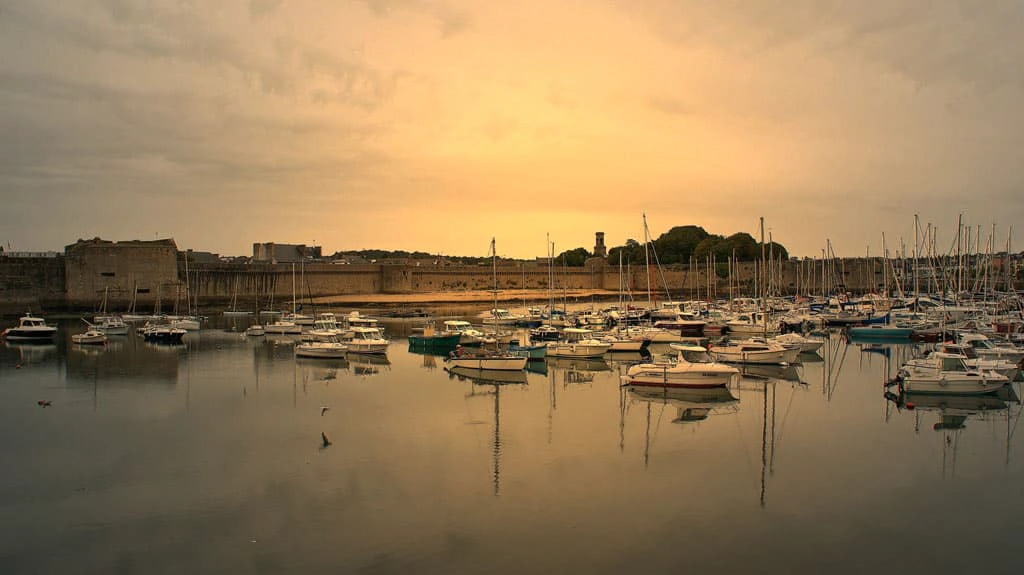
The fortifications of the walled town were no longer used for warfare, but were recognized as part of the town’s historical heritage. Today, the “chemin de ronde” offers superb views of the fishing and yachting harbours that encircle the fortifications, as well as of the entire bay of Concarneau.
Sites to discover in the Rose City
The Ville-Close is home to the town’s oldest dwellings: granite gabled houses lining the alleyways, alongside timber-framed houses, stalls with carved lintels and chapels converted into living quarters. There are many buildings to discover during your visit to the Ville-Close, such as..,
- The ramparts
- The belfry
- Saint-Guénolé church
- The fishing museum
The Ville-Close is a great place to mix a stroll with a gourmet break in one of the many restaurants or crêperies that line the narrow streets. Numerous singers, artists and jugglers regularly enliven the Ville Close.


